Sunday, July 31, 2011

Here A Button, There A Button

I would like to conclude my series on buttons by covering some other common types of buttons. 

Vegetable Ivory

First on my list are vegetable ivory buttons.  Vegetable ivory comes from the Tagua nut that grows on trees in South America.  This nut can be carved and finished to a fine ivory like finish.  They are very dense and dye does not penetrate.  Typically the button holes were drilled after they were dyed, so frequently you can tell a VI button by looking at the back.  Sometimes you can also see some graining.

                                                  Tagua Nuts

       Back of a Vegetable Ivory Button showing the dyed and undyed surfaces.

These buttons made their appearance at the 1862 Universal Exposition in Paris and were quite common between 1870 and 1920.1  This material was a cheaper, more abundant substitute for real ivory.  A resurrection of this type of button just might help save the rainforest by giving South American farmers an income from these nuts, thus encouraging them to plant more trees.

                             Some exquisite vegetable ivory whistles


Horn Buttons

Another natural material for making buttons is horn.  Horn can be heated and pressed into a mold, and thus able to be formed in intricate designs.  One of the tell-tale marks of a horn button is located on the back.  Often there is a pick mark in the back where it was pried from the mold

Buffalo horn buttons (whistles) showing front and back.  You can see the faint pick mark between the holes on the back.

Perfume Buttons

Perfume buttons were made for…you guessed it, perfume.  In the 19th century perfume was oil based, rather than alcohol based.  Women were justifiably concerned about perfume staining their clothing so they used metal buttons with velvet, fabric or hair inserts to place their perfume on.  When the men went off to war a woman might give him one of her perfume buttons to sew underneath his collar so that he could carry her scent with him. 

                            A perfume button with a velvet insert

Metal Buttons

My series would not be complete without mentioning metal buttons.  The Victorian Era was noted for being ornate.  Many of the metal buttons of the period reflected this ornateness.  They exhibited their love of the arts with picture buttons portraying stories.  These buttons have become very collectible, some of them bringing upwards of $75 or more. Most of the older buttons have a shank on the back.

Metal buttons showing the picture (although this is a rather simple example) and the back, showing the shank.


Tuesday, July 19, 2011

China Buttons

I would like to continue my series on buttons this week with a discussion of china buttons.  Calico buttons, which I covered in part one of this series, are a type of china but there are many, many more.  This week a picture will be worth a thousand words, so here we go…

Chinas come in many sizes, colors and body shapes.  Most of them were made in France.  The Bapterosses plant was one of the major plants there.


One of the body shapes is called an “inkwell”.  This is because it has sloping sides and resembles its namesake.  Inkwells come in many different patterns, including calicos. 

These buttons are “pie crust” buttons, named because of the fluted rim.


These are ringers.  I have seen pictures on the Internet of clothing dating to the early 1860s that have ringer buttons on them.  They have also been found on salesman’s sample cards alongside calicos, dating them to the same time period.  They come in many different colors and may have a single band or two or three bands.  I have some ringers that also fall under the pie crust category.


Hobnails are as the name suggests.  (top row).  Underwear buttons have big holes that are reminiscent of alien eyes (bottom row),


Another button that was common during the mid 19th century is the gaiter.  Gaiters are rounded or conical in shape, and most have metal shanks on the bottom.  Some gaiters have circular patterns and are known as “bulls-eyes”.  The button on the bottom is called a “bird cage” because of the type of shank. 


One of the most fun buttons is the “whistle”.  Whistle buttons have one hole at the top and two holes in the bottom (the second button from the left on the bottom row shows the back side).  This hides the thread inside the button and protects it from wear.  These whistles are fairly plain.  I have seen some that are works of art.


The last type of china that I will illustrate is the stencil.  It is very hard to find information on the inception of the stencil, although we know that they ceased being made around the World War II era.  At some point in the twentieth century they were also made out of aluminum.  These stencils look very different from the chinas.  Stencils come in several patterns and colors, although not as many patterns as calicos. 


If you are interested in china buttons and want to see more, I found a wonderful website that has many pictures on it.  I would recommend it for reference and if you just want the china “wow” factor.


For more information I would also recommend the book “Guidelines For Collecting China Buttons” by Ruth Lamm.  It is currently out of print, but is a good handbook if you can find one.

Next week I will conclude this series with a segment on vegetable ivory, metals and perfume buttons. 

Wednesday, July 13, 2011

Mr. Goodyear and Rubber

Back in the early 1800s trade ships brought rubber to the United States from the Indies.  Enterprising manufacturers began using the material to make products.  There was only one problem.  The rubber turned rock hard in the winter, and when summer came it melted into a sticky goo.  Customers began returning their products which had to be buried due to the smell.  Some of these manufacturers consequently went bankrupt.   Enter on the scene Mr. Charles Goodyear.  This man felt that it was his God given calling to find a way to convert this material into something usable.   He spent several years experimenting until he finally figured out a way to convert this precursor of plastic into something that manufacturers could use.  The process was called Vulcanization.  After this process was developed, rubber was able to be used in the manufacture of many products.  Mind you, this was decades before the advent of tires.

One of the items made from rubber was buttons.  When I first discovered rubber buttons I was intrigued.  When I think of rubber I think of something flexible.   Goodyear rubber buttons are hard.  If you put several in your hands and shake them the noise resembles the clink of poker chips.  Many of the buttons are marked on the back (back marked) with the Goodyear patent date (1851) and possibly the name of the manufacturer.  Common ones are:  IRC (India Rubber Company); N.R. Co (Novelty Rubber Company); A.R. Co (American Rubber Company); and D.H.R. Co (Dickinson Hard Rubber Company.  These buttons come in 16 different sizes, and many shapes and designs, including picture buttons.1  I will illustrate some of the different buttons here.  Please note that most of these shapes are commonly found in buttons made of other media as well.


An original card of Goodyears

A Goodyear back-mark


A rare brown Goodyear

A Goodyear whistle.  A whistle button has one hole on the top and two on the bottom.  This places the thread inside the button and protects it.  

A Goodyear with a metal shank.
Four of the many designs of Goodyear's  These buttons are found in two and four hole, and shank style among others.

Rubber was also used to make galoshes, also called "rubbers".  Pictured here is a pair of children's boots with rubber galoshes.


The bottoms of the boots are back marked with the Goodyear brand.


1 Gorski, Jill, "Goodyear Rubber Buttons", Bead and Button Magazine, 7/9/2011,  http://bnb.jewelrymakingmagazines.com/Community/Button%20Corner/NBS%20Articles/2009/07/Goodyear%20rubber%20buttons.aspx

Wednesday, July 6, 2011

Calico Buttons

When I started reenacting I was under the impression that the Victorians were so utilitarian that they only had buttons made from bone, shell, wood or other readily available, but primitive material.  The fact is that the Victorians were very fancy.   If you look at pictures from the era, you will often see buttons of a contrasting color gracing the front of a lady’s blouse or dress.  Their buttons were their adornment.  Buttons of the day were made of china, rubber, gutta percha, horn, metal, ivory and any other media available.  While I am not an expert, I will be starting a series here on Victorian buttons, and one of the most prized and sought-after buttons is the calico. 


Calico buttons are a type of china button, named after the fabric which it was created to compliment.  You can tell the difference between a china button and a plastic button by looking at the back.  A china button is rough where it sat in the kiln.  A plastic button is smooth, and may have a small dot where the plastic was injected into the mold.  China buttons also feel cooler to the touch, if you hold them to your cheek, than plastic.

Calicos got their start in 1840 when Richard Prosser patented a method of compressing a fine dry powder into a button, which was then fired.  The design is then affixed using transfer paper and then baked again.1  A whole cache of calico buttons were found on the wreck of the Steamship Arabia which sank in 1856 in Kansas.  This places them well before the Civil War. 

Buttons originally came on a card.  The purchaser would specify how many buttons they wanted, and the sales clerk would cut off the amount that was needed.  Many of the carded china buttons that I have seen indicate that they were made in France, in the Bapterosses plant. 

These buttons come in many different shapes, sizes and colors, and are available in two, three, and four hole.  Some even come rimmed with metal (these are rare and bring a good price on the market.)  Three hundred twenty six different patterns have been identified.  The most common calico is a colored pattern on white; however, there is also a white on dark variation.  Because of  the difficulty of finding complete sets of these buttons, reproductions are a reasonable alternative for living historians.  These are available at http://www.annaandabigails.com/. 


Whenever I go to a museum now, I look for old clothing to study the styles, the fabrics and the buttons.  I seldom see buttons today that can rival the beauty of these vintage buttons.  It is like wearing jewelry on your clothing.  Maybe we need to get back to basics and bring these buttons back into vogue. 

1 Lamm, Ruth, Beatrice and Lester Lorah, and Helen W. Schuler.  Guidelines for Collecting
       China Buttons.  Boyertown, PA.  1970.

Thursday, June 30, 2011

Lives Well Lived

A couple of weeks ago my husband and I traveled to Upstate New York to inter three of our parents’ ashes.  On the way back to Oklahoma we stopped in Washington, D.C. to visit my son, who is stationed at Ft. Myer, VA with the Old Guard (Army).  While there, we had the opportunity to watch as his company transferred someone from one grave site to another in Arlington.  It was done with great pomp and respect.  I know nothing about the person whose body lay in the casket.  I don’t know if they were male or female, old or young, whether they gave their life for their country or died of other causes.  It didn’t matter.  He or she was a veteran and thus, given a hero’s interment. 

While in D.C. we spent a couple of days seeing the sights.  The one monument that impressed and touched me the most was the Jefferson Memorial.  Inside the memorial stands a statue of Jefferson; the words “"I have sworn upon the altar of God eternal, hostility against every form of tyranny over the mind of man” are inscribed around the walls inside the edifice.  It made me think about the sacrifice that our founding fathers made to secure freedom for all. 

They were patriots to one cause and traitors to another.  If caught, these men would have been subject to execution King George III style (not a pretty sight.)  Yet they chose to put their very lives on the line to do what they thought was right.  William Ellery, the delegate from Rhode Island at the signing of the Declaration of Independence said, “I was determined to see how they all looked as they signed what might be their death warrant.  I placed myself beside the secretary Charles Thomson and eyed each closely as he affixed his name to the document.  Undaunted resolution was displayed in every countenance.”1 

These men pledged “their lives, their fortunes and their sacred honor”2 to birth our country.  Many men and women, since, have given their lives defending it.  Countless others have served  both at home and abroad.  Both of our fathers served during the Korean conflict—my dad in the Army, and my father-in-law in the Air Force.  I had an uncle who was stationed in Pearl Harbor when the Japanese attacked at the beginning of World War II.  Another uncle flew bombing missions over Germany.  All were veterans and devoted fathers.  Their lives mattered.  As we head into this holiday weekend, let us reflect on those who went before us and resolve, in like fashion to lead lives well lived, and do what is right, in whatever circumstances God places us.

Happy Independence Day to all of my readers!   

1Kurnan, Denise and Joseph E’Agnese, Signing Their Lives Away. Philadelphia: Quirk Books, 2009.

2 The Declaration of Independence.

Wednesday, June 22, 2011

Fortitude and Perseverance

I learned a lesson last weekend—a lesson about fortitude and perseverance.  These are qualities needed to survive the 19th century experience.  As our captain, Cleon Plunk, stated, “We really got a small taste of what it was like to live back then.”

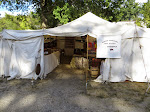
Vaunda and I made the 6 hour drive to Booneville, MO for their 150th anniversary reenactment.  We arrived Thursday evening and set up our tent, a process that takes about 8 hours total.  We finished sometime around noon on Friday. 

The weekend was hot.  We kept cool by misting ourselves with water, and drinking.  Lots of drinking.  I had taken my bathtub, so we were able to cool off with a bath at night.  The event coordinators had set up a water hose at the entrance to the site, so we had to carry our bath water a distance in a bucket, much like our predecessors had to carry it from a nearby stream.  The bucket that we had was a canvas bucket which works, but water also seeps through the canvas so my skirts were soaked before I got back to camp.  Two baths, two trips.

We dropped into bed Friday night (we sleep on an air mattress on the ground), and slept the sleep of the exhausted—until about 3 a.m.   The people in the next tent woke us to warn us that a prairie storm was rolling in with wind speeds of up to 75 miles an hour.  Shortly thereafter, one of the EMS trucks went through the camps with a bull horn, waking people and telling them that they had 10 minutes to batten down the hatches and get to their cars.  I appreciated the warning.  Often we don’t have that luxury. 

The sutler coordinator organized the sutlers to pull their trucks and trailers in front of their tents to serve as a wind block.  Because I had parked at the bottom of a hill, and it was dark and the terrain rough, I knew that I would probably have trouble getting my truck out, so I opted to leave it.  Vaunda and I headed for the coordinator’s tent and got a lesson in what to do to prepare for a storm.  We stayed there during the worst of the first storm.  When the wind died down we went back to our tent to prepare for the next storm.  We pounded the 2 foot stakes in further, moved displays and merchandise, and then, amid thunder and lightning, lay down to get some much needed sleep.

It stormed most of the night, and by morning, we had a nice, steady but gentle rain.  The wind picked up a bit and whipped our tent, causing the sides to drop in spots.  I set about fixing them.  Vaunda joined me.  Unbeknownst to us, the end of the storm was near, and with it, a strong gust front.  We were trying to shore up a sagging side when it hit.  I was at the corner pole, Vaunda at a side pole.  I put my weight into it, and struggled to keep the tent upright, as did she.  We struggled, and wondered how long the winds would last and how long we could continue to fight, and whether or not our tent would remain erect. 

Finally, the wind died down.  We dressed quickly and went out to survey the damage.  Some tents were down.  Their owners set about to re-pitch them and put their contents aright.  I spent the day re-setting stakes, ropes and poles.  We kept our eyes on the weather forecast, a luxury that the 19th century settlers didn’t have.  Another night of storms was predicted. 

I pulled my truck out of the hollow during the day, after the ground had a chance to dry.  Right before night fall, all of the sutlers, again, pulled their trucks and trailers in front of their tents.  All I could think of was that it was the 21st century equivalent of circling the wagons.  And that we were sitting ducks.  We had no place to go.  No shelter, save our vehicles.  Again, I went to bed amid the thunder and lightning.   Fortunately, the storms were not severe.  I slept until day break, when the rain finally stopped. 

I was happy to pack up and head home Sunday evening.  We were tired of battling wind, storms and heat.  After we came home we had a severe thunderstorm and I didn’t even care.  I was safe in my home, surrounded by strong walls and a roof over my head.  I slept right through it, in fact.

This experience gave me a deep awareness and appreciation for those who lived and struggled with the elements 150 years ago.  Nature can be very unkind.  Without the characteristics of fortitude and perseverance none would have survived long on the prairie.  For the weekend, at least, we followed in their footsteps, doing what needed to be done in the face of adversity, and persevering until the end of the weekend.


The camp at dawn
*My sincere thanks to the event organizers, the Missouri Civil War Reenactors Association, Dell and Jean Warren of James Country Mercantile and the EMS personnel who did such a fine job of hosting this event.*

Saturday, June 11, 2011

Classical Clothing—Costume or Couture?

“I like your costume.” 

I hear this frequently, and every time I do, I cringe.  Costumes, in my mind, conjure up images of Halloween and cheap costumes worn over clothing and fastened with ties or Velcro.  The clothing that I wear is more than just a costume.  My wardrobe is carefully researched, and the fabrics and buttons chosen to be in keeping with original period-appropriate clothing.

My Civil War dresses are collar-less and have dropped sleeves. My camp dresses, which date to an earlier era, have collars, and are shapeless.  I also have a bloomer outfit which was sewn from a picture of Mary Edwards Walker.

Under my dresses are period type undergarments.  My petticoats are muslin, reinforced with rope.  I may, or may not be wearing a hoop skirt.  In the winter I wear a double flannel petticoat, which keeps my lower half toasty warm.  My chemise serves a couple of different purposes.  It is long enough to keep me modest if I should fall with a hoop skirt on, and it provides comfort underneath my corset.  My corset is a working corset.  It is comfortable (except in hot weather) and provides good back support.  Last, but not least, are my pantalettes, mid-calf length with lace and eyelet trim.  If I dress as a 19th century woman I want to make sure that I am as accurate as possible so that I can experience the time period fully, right down to my skivies.

My shoes have been hand-made to fit my feet.  Black in color with square toes, they are made of leather with nailed on soles.  My stockings are standard sutler issue: striped and thigh high.  I wear my hair parted down the middle and pulled back in a bun.  The bun is covered by a black beaded, crocheted hair piece.  My watch is a pin-on type, which hangs from a chatelaine.  Depending on the season, I might be wearing a shawl or a peletot coat.  A bonnet or hat may also be worn.

 Some period items are hard to find.  It was much easier 150 years ago.  Today you consider yourself lucky to find someone who makes reproduction items.  The alternative is to scour auctions, yard sales and on-line websites to find originals in good shape.  Either way it is time consuming and costly. 

Costume?  Living historians don’t play dress up.  We take it very seriously, sometimes to the point of wearing our hair or facial hair (for the men) or spectacles in 19th century styles all of the time.  We pay attention to the details that no one else sees.  When we are at events (reenactments) the spectators are the ones who are dressed funny.  I think the next time someone tells me that they like my costume I will reply with, “Thanks.  I like your costume, too!”

Wednesday, June 1, 2011

Tents, Twisters, and Trains

Tents, Twisters and Trains

Several years ago we went to a reenactment in Atoka, OK.  As we pulled in and set up camp we looked at the sky and saw this:

The sky was beautiful, but also sinister-looking.  We knew that a storm was brewing. It was quite breezy, as it often is on the Oklahoma plains.   When you live in Tornado Alley you tend to keep your eyes on the sky. 

Vaunda, Brenda, and I pitched our tent in the civilian area, and expecting a storm, we lay plastic on the ground to protect us from the torrential rain that we knew would come. The idea was to have the plastic cover the gap between the bottom of the tent and the ground so that any water would have to go under or around us, thus keeping us dry. 

Needing to visit the port-a-johns, Vaunda and I headed in that direction, fighting the wind every inch of the way.  Once inside I shut the door and set about taking care of business.  The port-a-john shook like a paint mixer at the hardware store. 

“Has anyone ever been killed in one of these things?” I shouted to Vaunda, who was waiting outside.  Then we both began giggling. 

We went to bed at nightfall, just as the storm moved in.  It rained; it thundered; and the wind gripped our tent and shook it like a dog shakes its prey.  I lay there and prayed.  Hard.  I prayed for God’s protection for everyone there, and then fell asleep.  I was presently awakened by the sound of a train.  I had never been in a tornado before, but I had heard that the sound was like that of a freight train.  I listened.  The train sound came closer and closer.  Subsequently, the sound of a whistle pierced the night.

“Do tornados have whistles?” I asked Vaunda.  Then we both laughed. 

We were still laughing the next morning when we got up.  Everyone was fine.  Some were wet, but reenactors are “all-season” kind of people.  We began to inspect for damage.  We found it amusing that Brenda’s sleeping bag was wet.  The plastic that was meant to keep us dry had poked its way out from underneath the tent and acted as a funnel, channeling water inside the tent.  We hung her sleeping bag out to dry, then went to get something to eat. 

The event coordinators provided breakfast for the reenactors:  sausage, biscuits and gravy.  We tramped through the mud to get to the mess tent and stand in line.  What a hunger a storm can produce! 

The sun came out and began the task of drying things out.  The rest of the event went without a hitch.  We left happy but tired.  My son, Scott even fell asleep with his head in my dresses on the way home.  What a picture!

Saturday, May 28, 2011

Go West, Young Woman

Ever since I was a child I knew that I was born 100 years too late.  Over half a century later it is more like 150 years.  There is just something about the simplicity of life, the challenge of making do with what you have, the creativity needed to invent new ways of doing things and travel by train and horse that have always appealed to me.  My mantra was “Go West, young woman,” and go West I did, although not as I envisioned. 

As a teenager I married the farmer of my dreams and shortly thereafter we moved from Upstate New York to Oklahoma to go to school.  Here we stayed, one state away from the Rocky Mountains that I had dreamed about as a girl.  The land of cowboys, Indians, lawmen, outlaws, and land runs, Oklahoma had it all. 

Oklahoma had one other thing, too…Civil War Battlefields.  Who would have thought that the Civil War would have been as far reaching as Indian Territory?  But it was.  And in a roundabout way I was introduced to Civil War reenacting.  I hung around at several reenactments before jumping in with both feet.  I wanted the full experience of living the life of a nineteenth century woman.  Now it defines my life.  By trade I am an accountant; but a Civil War reenactor is who I am.  I have more 19th century dresses than I have modern ones.  My library is painted blue and grey and a mural of the Federal and Confederate flags is painted on one wall.  I sew on a treadle sewing machine.  My home, my life, and my business revolve around a time far removed from the modern world.

Here  you will find the musings of a 19th century woman or a 21st century misfit, take your pick.  I will ruminate about 19th century topics and convey a sense of what it is like “living in another time”.  This is the next best thing to time travel.  Come join me for a journey back in time.

----Kim, aka Abigail----